Agile Transformations Fall Short When Organizations Focus on Doing Agile Rather Than Being Agile, Finds Info-Tech Research Group
Canada NewsWire
ARLINGTON, Va., Aug. 5, 2026
Many organizations adopt Agile delivery methods but struggle to realize their full benefits because people across the organization lack a consistent understanding of Agile fundamentals, principles, and practices. Info-Tech Research Group's recently published blueprint, Develop Your Agile Approach for a Successful Transformation, provides a practical framework to help IT leaders identify their most pressing Agile challenges, establish a shared foundation, and apply targeted modules to improve delivery.
ARLINGTON, Va., Aug. 5, 2026 /CNW/ -- Organizations often turn to Agile delivery methods to shorten delivery time, improve quality, and respond more effectively to change, but Agile transformations can be complex and difficult to implement. Insights from global IT research and advisory firm Info-Tech Research Group show that success requires more than adopting iterative processes. It depends on establishing a shared understanding of Agile fundamentals, principles, and practices, as well as the role each person plays in the transformation.
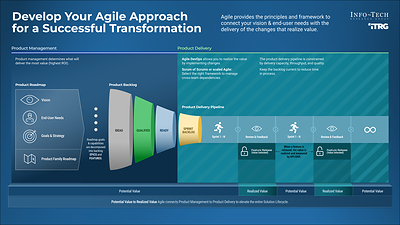
Info-Tech's blueprint, Develop Your Agile Approach for a Successful Transformation, explains that organizations can struggle when employees have conflicting or inadequate knowledge of Agile practices, teams are unsure whether they are applying Agile effectively, and different areas of the organization use inconsistent approaches. Rather than applying a single solution to every Agile challenge, the firm recommends identifying the organization's most pressing pain points and directing support where it is needed most.
"Agile transformations are more likely to be successful when the entire organization genuinely understands Agile fundamentals, principles and practices, as well as the role each person plays in its success," says Hans Eckman, Research Fellow at Info-Tech Research Group. "IT leaders need to focus on developing a solid understanding of Agile practices so that their organization can be Agile, not just do Agile."
Common Challenges That Limit Agile Transformation Success
Although Agile delivery practices are widely used, organizations can encounter numerous obstacles that prevent teams from realizing their intended benefits. Info-Tech's research highlights several common challenges:
- Conflicting or inadequate knowledge of Agile principles and practices, resulting in inconsistent application across teams.
- Resistance to change, insufficient training and coaching, limited management support, and organizational structures that make autonomous delivery difficult.
- Delivery challenges involving product ownership, backlog management, estimation, product roadmapping, governance, quality assurance, and collaboration with non-Agile teams.
Info-Tech's Framework for Building Agile Understanding
To help organizations address these challenges, Info-Tech's Develop Your Agile Approach for a Successful Transformation blueprint recommends an approach that combines foundational learning with targeted support:
Phase 1: Identify Common Agile Challenges
Product owners, product managers, scrum masters, delivery managers, senior leaders, stakeholders, and delivery teams complete the Common Agile Challenges Survey to identify and prioritize the organization's most significant Agile pain points.
Phase 2: Establish a Solid Foundation for Agile Delivery
Teams build a common understanding of Agile fundamentals, examine why becoming Agile can be difficult, interpret the survey results, and develop a roadmap for the organization's transition to Agile delivery.
Use Agile Modules to Address Priority Pain Points
Organizations select modules based on their highest-priority challenges. Available modules address areas such as backlog management, scrum simulation, minimum viable product, estimation, product ownership, product roadmapping, Agile for commercial off-the-shelf implementations, collaboration with non-Agile teams and vendors, Kanban, and Agile maturity.
Info-Tech's Develop Your Agile Approach for a Successful Transformation blueprint includes ready-to-use tools and resources such as the Common Agile Challenges Survey, Roadmap for Transition to Agile, Agile Maturity Assessment, and Scrum Simulation Module. These resources are designed to help IT leaders establish a consistent Agile foundation, prioritize organizational pain points, and provide targeted support that strengthens Agile practices across teams.
For exclusive and timely commentary from Info-Tech's experts, including Hans Eckman, and access to the complete Develop Your Agile Approach for a Successful Transformation blueprint, please contact pr@infotech.com.
About Info-Tech Research Group
Info-Tech Research Group is the "get things done" partner for over 30,000 IT, HR, and marketing leaders worldwide. The fastest growing research and advisory firm, Info-Tech enables leaders to make well-informed decisions and transform their organizations through AI, strategic foresight, step-by-step methodologies, practical tools, industry-leading advisory, and training programs. For nearly 30 years, tens of thousands of private and public organizations have trusted Info-Tech to lead their most important initiatives through periods of change and deliver outcomes that truly matter.
To learn more about Info-Tech's HR research and advisory services, visit McLean & Company, and for data-driven software buying insights and vendor evaluations, visit the firm's SoftwareReviews platform.
Media professionals can register for unrestricted access to research across IT, HR, and software, and hundreds of industry analysts through the firm's Media Insiders program. To gain access, contact pr@infotech.com.
For information about Info-Tech Research Group or to access the latest research, visit infotech.com and connect via LinkedIn and X.

 View original content to download multimedia:https://www.prnewswire.com/news-releases/agile-transformations-fall-short-when-organizations-focus-on-doing-agile-rather-than-being-agile-finds-info-tech-research-group-302844040.html
SOURCE Info-Tech Research Group


